



 Posts
Posts





"Inner Voice is a meditative inner journey meant to awaken the primeval powers slumbering at the very depth of the "Self". It is a bringing up to the surface the energies of the ancient elements of earth, water, fire and air with the natural means of music and harmony.
We can only reach the very depth of our selves by the help of growing silent completely, a turning inward in meditation. The touching of the primeval powers slumbering in the depths of our "Self" happens when we use the most ancient of string instruments, that is, the human voice, archaic Hungarian folksongs, Gregorian chants and special instruments that awaken the four archetypical elements."
1. Föld / Earth
2. Víz / Water
3. Tűz / Fire
4. Levegő / Air
5. Belső hang / Inner Voice
Irén Lovász - voice
János Kerekes - didgeridoo
Ágnes Pintér - harp
Gergely Balázs - violin
Judit Gesztelyi Nagy - shakuhachi
Zoltán Mizsei - voice
Link
pass: bluesmen-worldmusic.blogspot.com

"MAKÁM Group is the most characteristic Hungarian representative of the New Tradition. Its landmarks are eleven albums. Its music spans tradition and modernity, the East and the West, the duality of the collective and the individual and search for the ancient harmony.
The group which was founded by Zoltán Krulik, broke into musical life here as the Eastern Central European follower of the ethno-avantgarde trend, this period was nuanced by Asian, Far Eastern roots as well as Balkan, African effects or repetitive elements of contemporary music.
The latest period of MAKÁM Group (SkanZen, 2000; 9 Colinda, 2001; Sindbad, 2001 - Fonó Records; Anzix, 2003 - FolkEuropa) is characterised by the rediscovery of the archaic forms of Hungarian folk music and that of the song first of all.
The legacy of Bartók and Kodály, the synthesis of elements of archaic cultures and contemporary age is the unchanged musical credo of the MAKÁM Group.
The Makám ensemble was formed in 1984 with the purpose of establishing a peculiar form of community played music, and trying to show the common characteristics existing in music cultures of different peoples and contrasting musical forms. This is a sort of improvisative chamber music containing the elements of classical music as well a contemporary jazz and rock. Its melody and rhythm are influenced by East-European ethno and Oriental music. Beleiving that the ancient Hungarian folk music is deeply related to Eastern traditions, the group arrivedat cultures geographically far away from Hungary.
The name of the group, Makám, is a word of Persian-Arabic origin, referring to the structural signif icance in improvisational music. Particular chords in the band's style are due to the rarely heard rhythms and melodies on one hand, and, on the other to the original collective sound of instruments never experienced in the same way before. Besides the classical instrments such as saxophnes, clarinet, oboe, guitar, double-bass, the tunable tabla and two ancient instruments, the Balkanien kaval (wind instrument) and the Indian ghatam play an important role in the group's sounding.
Furthermore, several exotic stringed instruments plucked with a plectrum, and percussion instruments, such as marimba, kalimba, bamboo sansas, ektar, talking drum and bells, colour the harmony of the music. Most of these instruments are made by the group's idly on the original function of the instruments but tries to explore new possibilities in playing techniques, tonality and soring. They have made many discs and radio recordings of classical music and etno contemporary music in Hungary and abroad, and have given concerts in festivals, concert halls and jazz clubs throughout Western Europe with great success. The Makám is a most exciting creative group of the latest years. It has attracted attention to an impovisational, accord combining elements of contemporery music as well as jazz and rock with the roots of Eastern European, Asiatic and Balkan folk. Its name was once linked to that of the Kolinda already world-famous at the time. By now, it has become a determinative formation in world music."
9 Colinda:
"Kolinda is the comprehensive name of pastorals as well as Christmas carols, Nativity and new year songs in the Roumanian – and Slavic – speaking countries in Eastern Europe and the Balkan. It has its roots in the Middle Ages, coming from the Latin world calendae. It has been found in Polish manuscripts since the XIIth century. Kolinda texts and functions have never had an exclusively ecclesiastic character. The songs have been of Roumanian children going begging from door to door – just like Christmas carol singers in Hungary – and of Polish people playing the Nativity or tending a flock. Kolinda tunes were treated by Chopin as well as Bartók."
01.Mennyei szép hajnal - Heavenly beautiful dawn
02.Hajdan rég - Once for a long time
03.Ő jön a szánon - He comes on the sleigh
04.Hull a tél haja - The hair of the winter is falling
05.Magnificat
06.Ó jöjj, ó jöjj - Oh come, oh come
07.Földből lettünk - From an Earth we were
08.Mikor a messiás - When the Messiah
09.Hajda a szélben - Hajda in the wind
Irén Lovász – voice
István Grencsó – saxophone
Balázs Thurnay – kaval, udu, voice
Eszter Krulik – violin
Zoltán Krulik – guitar, voice
Zoltán Mizsei -- synthesizer, voice
Balázs Horváth – double bass
Csaba Gyulai - percussion
Link
pass: bluesmen-worldmusic.blogspot.com

Irén Lovász is not only one of the most respected Hungarian folk singers in the world. She is also an academic scholar in Human Sciences, she is a doctor (PhD) of Ethnography. She combines very well her scientific knowledge and her musical talent in her solo concerts, lectures and performances. Irén grew up in the middle of Hungary. In her family folk songs were sung on a daily basis and she learned her first folk songs from her parents and grandparents. As a university student of Linguistics and Literary Sciences she went on singing and began to collect and study ancient Hungarian folk songs in different regions of Hungary and the Carpathian Basin: Romania, Slovakia, Croatia among ethnic Hungarians.
From 1987 - 1995 she worked as an ethnomusicologist at the Hungarian Museum of Ethnography, Department of Ethnomusicology dealing with the famous collection of Béla Bartók, Zoltán Kodály and László Lajtha.
In 2003 she has got The SINGER OF THE YEAR eMeRton AWARD in Hungary.
In 2005 she set up a new band, and with them she made a new cd: Cloud Doors. The new music is based on archaic Hungarian folk songs, sacred songs and medieval Gregorian chants. The style is: ethno-jazz, worldmusic, crossover.
01 Motto
02 Polorum Regina
03 Angyali üdvözlet / Angelic Salutation
04 Én fölkelék / I arose (első versszak nélkül)
05 Ó, Szent István / Oh, Saint Stephen
06 Ave Maris Stella
07 Alle-alleluja / Alle-alleluyah
08 Mária, Mária / Mary, Mary
09 Menybe vitt leány / The Girl Taken up to Heaven
10 Fellegajtó / Cloud-doors
11 Altató / Lullaby (Én fölkelék, első versszakkal)
LOVÁSZ Irén (ének / voice)
LUKÁCS Miklós (cimbalom)
SZOKOLAY DONGÓ Balázs (duda, furulya, szaxofon / bagpipe, recorder, saxophone)
MIZSEI Zoltán (szintetizátor, ének / synthesizer, voice)
FARKAS Zoltán (gitár, basszusgitár / guitar, bass guitar)
GYULAI Csaba Gyulai (ütőhangszerek / percussion)
Link

.. The soul re-sounds, words sing, love’s doors is ringing”
"This record was born in Bartók’s honour, on the 125th anniversary of his birth. The Budapest Spring Festival asked me to create a piece of music to go on the same program with Bartók’s „Bluebeard’s Castle”. The idea was that Bartók’s sources for this opera – the most beautiful layers of Hungarian folk songs, ballads and instrumental folk music – should be performed by me and my colleagues. Specifically that we should make use of them in our own style, bringing them to life, re-creating our musical tradition. This is how „Lover’s doors” came about; through the balladic world of Bartók’s opera – another story is told in a cycle of seven movements. For help we summoned the dramatic density of folklore’s surreal and symbolic images along with the lively folk music and dance. Though we sing about mythical, poetically named women with fates similar to Judit’s, rather than leading to tragedy, love’s doors lead to hope. The passages neither separate nor conceal, they do not have doors locked with a key; they instead connect the many levels and paths of human feelings and emotions. Re-sounding, they propel our souls out of grief and sorrow into the light; out of misery towards recovery."
1. Tavaszkapu / Spring’s Gate
2. Balladavölgy / Valley of Ballads
3. Varázsmező / Enchanted Field
4. Selyemrét / Silk Meadow
5. Citruserdő / Citrus Forest
6. Fellegajtó / Heaven’s Door
7. Álomvíz / Dream Water
Bea Palya, Ági Szalóki, Kati Szvorák – voice
ETNOFON ZENEI TÁRSULÁS
Ferenc Kiss – violin, viola, voice
Zsigmond Lázár – violin
Mihály Huszár – double bass
Attila Korom – guitar
Dávid Küttel – synthesizer, accordion
Károly Babos – percussion
HEGEDŐS BAND
Csaba Ökrös – violin
Sándor D. Tóth – viola
Zsolt Kürtösi – double bass
Kálmán Balogh - cimbalom
Mihály Dresch „Dudás” – saxophone, wooden flute
Mátyás Bolya – koboz, zither
Pál Havasréti – hurdy-gurdy, hit gardon
Balázs Szokolay „Dongó” – saxophone, bagpipe, tárogató, kaval, wooden flutes, overtone singing
Link

Makám's music can be seen as a specialized branch of today's music with its own eclecticism. It is characterized by a synthesis of different organizational of forms, a special cohesion of influences of different kinds of musical inspiration and the result of studying contemporary music, archaic traditional music as well as the spontaneous improvisation of free music.
Makam was formed in 1984 with the purpose of establishing a peculiar form of community playing music, a special synthesis of harmonies, trying to show the common characteristics belonging together in music cultures of different peoples and contrasting musical forms.
01. Szindbád
02. Fonó
03. Mátyus
04. Kisteknőc
05. Malom
06. Panyiga
07. Este
08. Kis Mózes
09. Balaton
10. Tá tia tá
11. A néma halfiú
12. Vadgesztenye
13. Anzix
14. Zengővárkony
15. Vándor
16. Betlehem
17. Madárijesztő
18. Zöld csoda-fény (Weöres Sándor)
Musicians:
Zoltán Krulik - guitar, Indian harmonium, piano, voice
Irén Lovász - voice
Balázs Thurnay - kaval, tin whistle, Moldavian flute, marimba, earthen drum, voice
Eszter Krulik - violin, voice, whistle
Csaba Gyulai - Turkish violin, udu, drum, percussion
Zoltán Kovács - contrabass, cow bells
Composed by Zoltán Krulik
Link
pass: bluesmen-worldmusic.blogspot.com

"Világfa (World Tree) is a mythological image that exists in the Hungarian culture and in other cultures as well. The branches, trunk and roots tie together the various dimensions of space and time in the real world and in virtual reality. And this is what this recording, "Világfa" (World Tree) aims at. This collection strives to represent the colourful and many-layered ancient Hungarian folk-songs through the use of ancient carols and musical parallels from other related cultures, starting with the various references to the magical stag from ancient Hungarian mythology, and making a sweeping arc from East to West with examples of different Hungarian folk-songs to show the similarities and unique qualities of the Hungarian folk-songs of each region. Parallel to this, however, the possibility emerges for a kind of musical synthesis not normally achieved in the traditional lifestyle, several examples of which can be heard on the recording. This is a musical journey in virtual time and space; playing with the notion of what cultural possibilities there might have been if Hungarian forefathers had headed eastward or southward from their ancient Western Siberian homeland instead of going to the West. The music on this recording also shows how the richness and universality of original Hungarian folk music lends itself to integration with old and contemporary musical languages of other cultures, as is the practice within today's world music and the future electronic world."
01. Megjöttünk, Megjöttünk...- Conquest
02. Regélők, Míg Élők - Till I Live, I'll Chant Tales
03. A Vöröslő Nap Felkeltekor - Chuvas Sunrise
04. Márton Szép - Ilona Fair Ilona Márton
05. Szivárvány Havasán - On A Rainbow's Snow-Mount
06. Bizánci "Porka Havak" - Bizantine Parallel
07. Porondos Víz Martján - On The Watex's Stony Bank
08. Magamnak Marasztom - Little Lass
09. Páva - Hey, Peacock
10. A Pünkösdi Rózsa - Tuberoses
11. Udvarom Közepén - Two Fair Lovers
12. Jaj, De Szépen Virjadozik - The Dawn Is Cracking
13. Szállj Le Kicsi Madár - Alight, Little Birdie
14. Jól Gondold Meg Rózsám - Mull It Over, Sweetheart
15. Ahol Én Elmegyek - The Trees Start Crying
16. Rabnóta - In Chains
17. Virágok Vetélkedése - With Thee, My Flower
18. Hidegen Fúj A Szél - Cold Winds
19. Hej, Révész, Révész - Ferryman
20. Esteledik, Alkonyodik - Sun's Setting
21. Aratóénekek - Harvest
22. Két Tápéi Dal - Tisza River
23. Elment Az Én Rózsám - My Rosebud Departed
24. Két "Dudás" - The Two Bagpipers
25. Zörög A Cidrus - Cypress Shakes
26. Imhol Kerekedik - Yellow-Foot Raven
27. Szánom-Bánom - Wide Is The Danube
28. Estéli Imádság - Colors Of The Earth
Link

Ancient Hungarian folk songs with contemporary accompaniment - the unique sound of Makám. Makám was formed in 1984 with the purpose of establishing a peculiar form of community playing music, a special synthesis of harmonies, trying to show the common characteristics belonging together in music cultures of different peoples and contrasting musical forms.
This is a sort of chamber music containing the elements of ancient Hungarian folk music, classical and contemporary music as well as jazz and rock. It's melody and rhythm are influenced by the East European, Balkan, African and Oriental music.
We are convinced that the ancient Hungarian Folk Music is in deep relation with Eastern Traditions. So we arrived at the cultures which are, geographically, far from Hungary.
01.Gyöngyvirág
02.Akármerről fújjon
03.Kerek a szőlő
04.Elindultam
05.Édesanyám
06.Fúdd el jó szél
07.Kiszáradt a tóból
08.Tilinkós
09.Estéli imádság
10.Vadászat
Musicians:
Lovász Irén - voice
Bognár Szilvia - voice
Grencsó István - sax, "tilinkó", harp
Thurnay Balázs - kaval, udu, flutes, vocals
Bencze László - double bass, piano
Krulik Eszter - violin
Mizsei Zoltán - sansa, chimes, vocals
Gyulai Csaba - udu, debourka, viola
Krulik Zoltán - guitar, piano, Roland W30
Lengyelfi Miklós - bass
Szőke Szabolcs - gadulka
All the music is composed by Zoltán Krulik, based on traditional Hungarian folk songs
Link
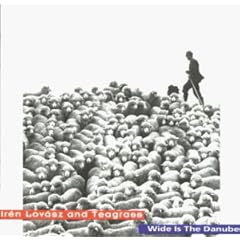
The inspiration for this encounter between Hungary's Iren Lovasz and the folk-jazz-bluegrass band Teagrass came from Michal Shapiro, a New York-based music producer and journalist. As usual, Shapiro was right. There could be no better companions for a musical exploration of the various ethnic enclaves and nationalities living along the Danube River. Balkan, Gypsy, and Jewish tunes turn up, flanked by several songs of specifically Moravian or Hungarian origin. The acoustic nstrumentals are creative, tight, and clean. Teagrass employ a hurdy-gurdy, viola da gamba, fiddle, clarinets and saxophones, plus flutes and bass, but the mandolinist makes the strongest impression. The group has an eclectic quirkiness that is refined but not inhibited by Lovasz's erudition and cultural integrity, and the ensemble provides an ideal setting for her flawless singing.
01.Nem egyszer
02.Vüstyi, vüstyi
03.Kdyby mne tak bylo
04.Verjen meg az Isten
05.S örözgeti vala
06.Üstyen, Üstyen
07.Szól a kakas már
08.Piros pántlikámat
09.Kedz sa mily
10.Márton Szép Ilona
11.Hegyen, földön
12.Byla cesta
13.Széles az a Duna
Link
